The next question in genomics
How does code
become life?
A genome is a sequence. An organism is a world of structures, systems, and behaviors. We’re building the map between them.
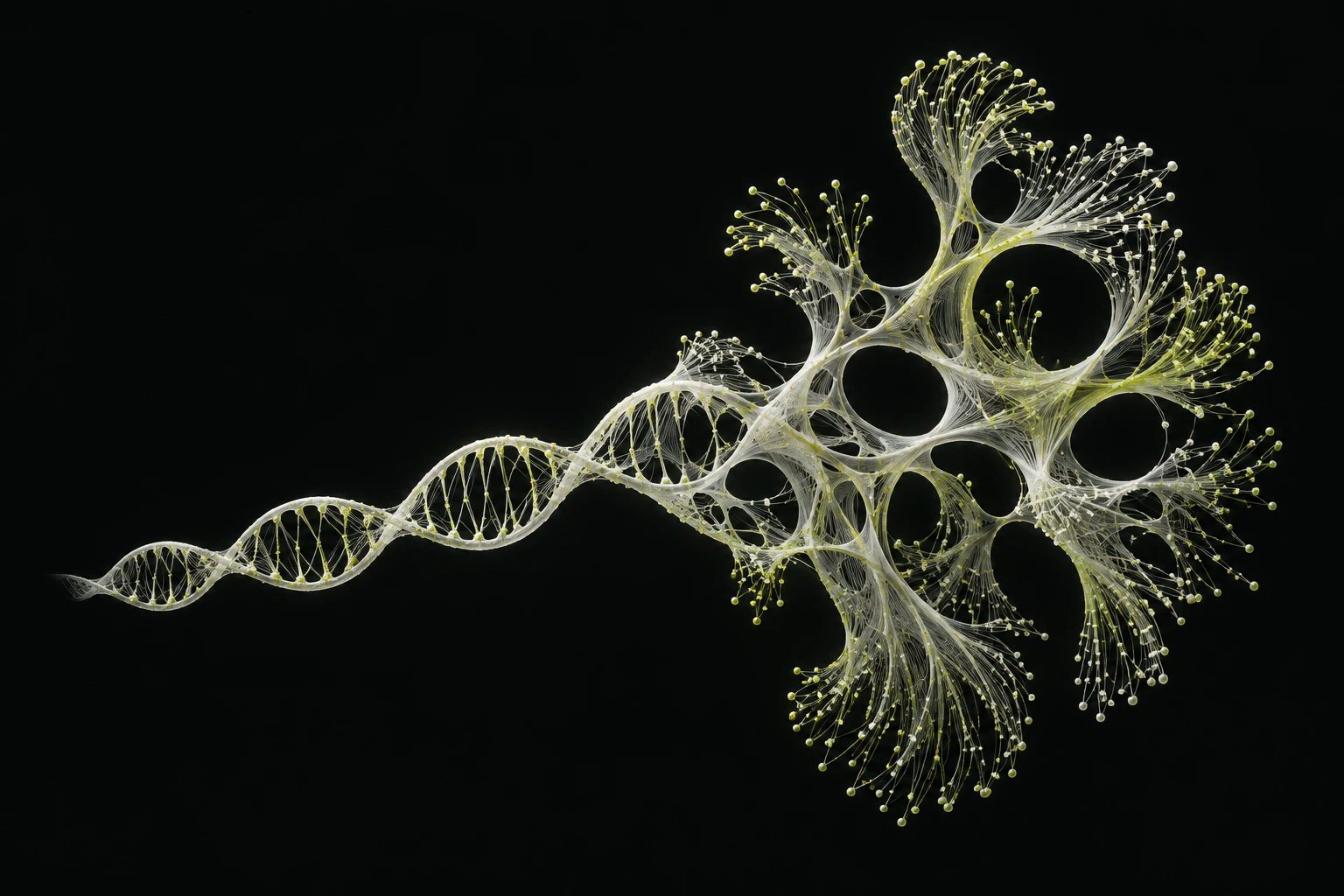
CONCEPTUAL ART · NOT EXPERIMENTAL DATA
A long-term question.
Testable steps forward.
DEVELOPMENTAL BIOLOGY
MACHINE LEARNING
Understand the rules
that build living form.
Why does one genome produce fins, another wings, and another neither? Which differences in sequence help explain differences in anatomy?
DNALYZER is building a connection between public genome records and detailed, sourced descriptions of organisms. We test whether genomic differences explain traits across evolution, and use those results to choose the next experiment.
The ambition is broad. Our evidence is specific. We have built an initial atlas and tested early models; we have not decoded a universal language of life.
Start with the organism.
Body structure, development, physiology, and context. More than a species name.
Learn from evolution.
Independent changes in anatomy can help distinguish a functional signal from shared ancestry.
Let experiments decide.
Compare against strong controls. Report what works, what fails, and what remains unknown.
A growing map of
genome to organism.
The first dataset links reference genome records with source-backed phenotype assertions. Coverage is partial and varies by species.
One complete genome assembly downloaded and verified. Most sequence files remain indexed. Species descriptions are not measurements of the sequenced individual.
Spotted green pufferfish
Tetraodon nigroviridis
342.8 million nuclear bases
Plus mitochondrial DNA · one haplotype
- Dorsal fin rays
- 12–14
- Anal fin rays
- 10–12
- Nostril tentacle
- 2 lobes
Species-level descriptions · USGS
Progress is evidence.
Including the negative results.
Public summaries of our experiments and the science shaping the next questions. Early research notes, not peer-reviewed papers.
Which paths could change how we age?
22 research paths. 42 linked sources. An executed evidence audit and the next tests worth funding.
Building a genome–phenome atlas
3,014 species profiles. A first prediction test. The ancestry baseline we still need to beat.
Where the next signal could come from
Repeated changes in body structure, regulatory DNA, and the tests that could move us forward.
Anatomy prediction meets a stronger control
A new test in 32 mammals. What remains after accounting for body size and relatedness?
A correlation is a lead. A prediction is a test. An explanation must survive competing explanations and independent validation.
What does it cost
to find out?
Test budgets, explicit probabilities, and customer-based market scenarios for every current research path. Inspect the evidence and change the assumptions.
Planning estimates. Unvalidated markets. No breakthrough probability is claimed.
Forming the founding research team
A difficult question.
A team worth building.
We’re bringing together people who can connect biological structure, evolutionary history, and computational experiments.
We value careful experiments, clear writing, and the willingness to abandon an idea when the evidence changes.
Read the research agenda